
Hybrid fund math
FPVP Decoder Ring (Part 3 of not sure)

We often get questions on how the math works for a hybrid fund, so… here you go!
DISCLAIMER: There is all sorts of micro fund math on fees, fee recycling, interest on the balance, interest paid on a line of credit, catch-up interest (and more) that I’m not including in this post because this is high level and I am hoping you will stay awake.
First, on fund structure — a hybrid fund offers both venture capital funds and startups in the same closed, diversified, long-term vehicle.
We believe 60/40 is the right mix — at least at this moment in the Southeast. And so a hypothetical, easy math $100M fund would include ~$60M of capital into fund partners and ~$40M of capital directly into startups.
Hybrid funds start by establishing fund partnerships in order to:
Build relationships with top (but often lesser known) managers
Extend a net into a variety of stages, verticals, industries, vintages, and cycles
Maximize high quality, pre-qualified deal flow
Protect against the downside (principal loss)
Manage the J-Curve (mitigate early nose dives)
Fund partners provide a capital call schedule for their investment period — typically 4-6 years which helps smooth capital calls overall and manage IRR.
Hybrid funds then target and add direct investments into top startups in order to:
Provide risk-adjusted upside
Build ownership as risk decreases
Average down fees and carry to market rates
Leverage information asymmetry built through fund partnerships
Facilitate direct access for our LPs
About 40% of the capital is allocated to direct startup investments, with half of that capital allocated to initial checks, and the other half reserved for follow-on investment that is aimed to double-down quickly and aggressively into winners.
Next up, on fees in a hybrid fund — yes, they do have two layers of fees (gasp).
The first layer goes primarily to fund partners:
Fund partners typically earn the market standard 2% (management fee) and 20% (carried interest). 2 AND 20 is a commonly used term, but is actually not an accurate one, because the vast majority of funds return principal INCLUDING fees before divvying up carried interest, so the math really act like 2 OR 20.
Hybrid funds like ours DO NOT pay fees on direct investments, regardless of who shares them, creating a discount to the 2 OR 20 that you would otherwise pay.
A second layer of fees occurs to the GPs of the hybrid fund who curated the vehicle.
This is the point where brows can sometimes furrow — but since the first layer represents a discount to market fees, the combined math ends up at roughly 2 (and a bit) OR 20 (and a bit) on the unified, diversified, hybrid vehicle.
Last thing — if you believe that proper diversification is crucial to venture investing (which is like ‘ believing’ in math since returns dispersion is historically 8-10x wider compared to public equities), then you need A LOT of money to get diversified… or you need a hybrid vehicle.
I’ll start by frustrating some people: I love angel investing, and am an angel investor myself, and there are a lot of great reasons to be an angel investor, but only the biggest of strategic angels have the checkbook and deal flow to build a portfolio in venture that is properly diversified and well-positioned for long-term returns.
Most other angels are stock pickers of sorts — but with extremely limited data, deal access, and perspective on the relative quality of deals they are being shown.
Our Grand, Unified Theory of Venture is that you can be a stock picker (we all have our personal accounts of public stocks that we like) — but ONLY after you’ve invested in a base of diversification in the asset class that protects against your principal and puts you in a position to chase upside with your individual company selections.
Front Porch creates hybrid funds that are purpose-built for venture and offer a diversified foundation of hundreds of startups in a unified portfolio with a lot less time, money and effort. If you wanted to DIY, here is the rough math PER YEAR:
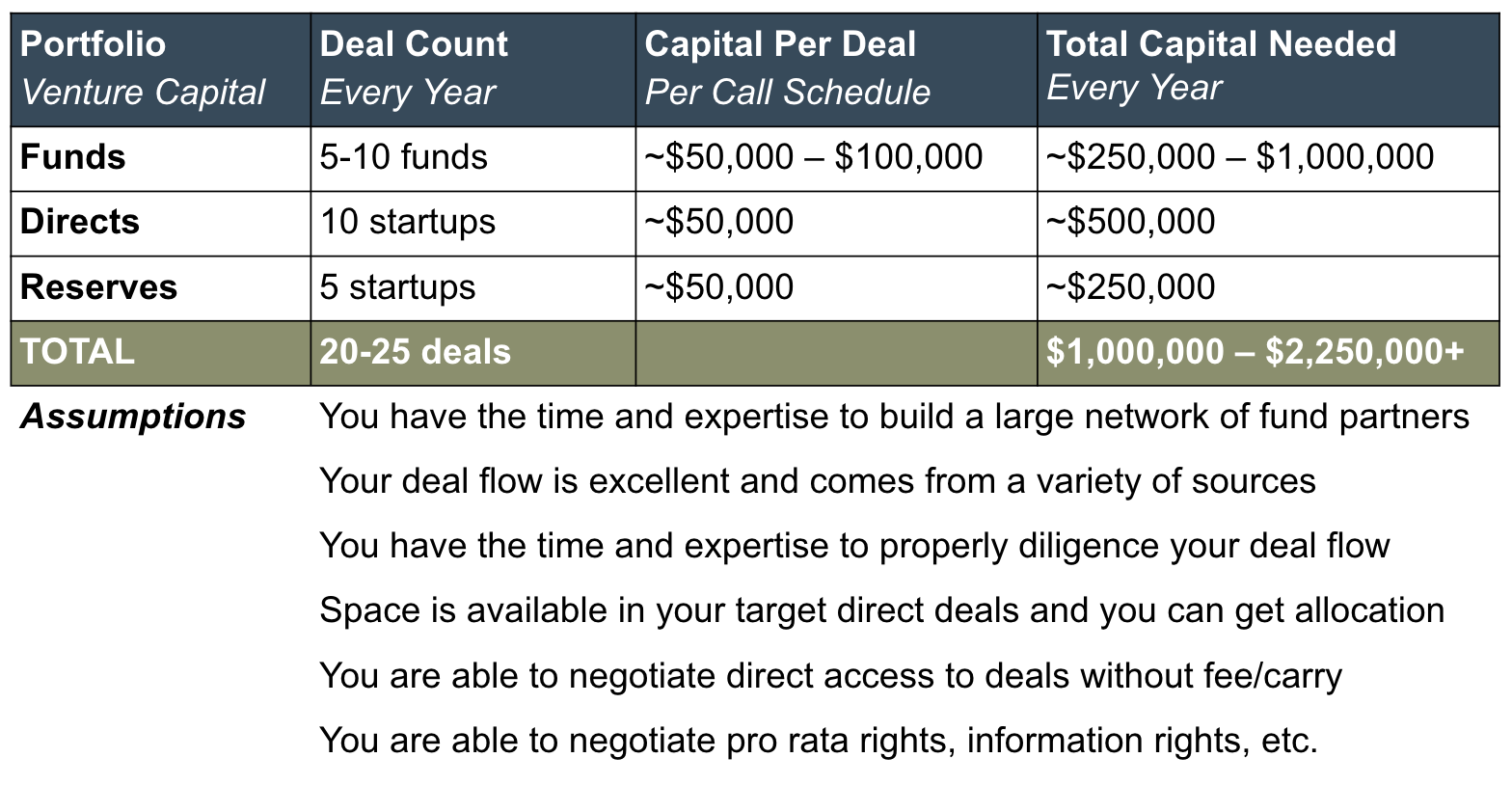
Investing in a hybrid fund is… materially less expensive. And even if you are an accredited investor who is an active angel, or a family office who is active in the private markets, or an institution with a big checkbook — a hybrid vehicle can help ensure that your time, energy and money is deployed efficiently into what is a historically one of the best performing asset classes, but also one that is high-risk, widely-dispersed, and long-term.
Still awake…? Send us questions as we can help clarify things and thanks for reading.